Tampilkan postingan dengan label marxism. Tampilkan semua postingan

Senin, 10 Desember 2012

Eurozone: An Italian job and a Greek tragedy

by Michael Roberts

So Italy’s ‘technocrat’ prime minister Mario Monti has decided to resign.  Once former right-wing billionaire premier Silvio Berlusconi announced that he was withdrawing the support of his weirdly entitled “People of Liberty” (PDL) party, Monti called Berlosconi’s bluff and Italy’s president Napolitano will probably announce an election in the next few days for late February or early March, just a couple of months earlier than planned.

It is just over a year since Monti took over after the EU leaders, Merkel and Sarkozy, organised a coup to remove Berlusconi by demanding that the Italian government impose austerity to meet fiscal targets or face financial penalties.  Under that threat, members of Berlusconi’s own party buckled and forced him to step down.  But now Italy’s own Murdoch-style) media mogul has decided that the political mood has changed enough in Italy for him to challenge Monti.  Also, there is a growing likelihood that he could soon end up in jail from a myriad of tax evasion, sex and corruption charges now under way.  So he needs to try and gain power again.

Monti has been the darling of finance capital and the financial markets.  In his year of office, he has imposed stinging fiscal austerity and attempted to ‘deregulate’ labour markets and dismantle Italy’s already rickety welfare state.   The Italian government is now running a surplus of tax revenues over spending (before interest payments on debt) and next year plans to balance the overall budget.  The hope is that this will lead to a stabilisation of the public sector debt ratio, which was the highest in the Eurozone before the global financial crisis and will still be the second highest after Greece in 2013, at 128% of GDP.  Monti slashed spending, introduced a wave of privatisations, reduced the value of public sector pensions, raised the retirement age and contributions on all pensions and has tried to get rid of employment protection rights and lower wages.

Financial markets have been very pleased with Monti and the cost for the Italian government to borrow money has dropped substantially.  But Italy’s people have been less pleased and Monti’s electoral popularity, which was sky high to begin with, has now plummeted as fast as it has risen with finance capital.
Although austerity may have worked for financial markets, it has not worked in reviving the Italian economy after the global slump.  This year, the economy will have declined by 2.5% in real terms and next year the forecast is for another 1.0-1.5% fall.
Itay real GDP
Indeed, real GDP has barely risen since the European single currency came into operation, making Italy the worst-performing country in the Eurozone.   The overall unemployment rate has jumped from 8.8% a year ago to 11.1% (although still below the euro-zone average); and for young people, it is a desperate 36.5% (well above it).  Italy’s track record is abysmal.  In the last decade or so, euro area average labour productivity has risen about 8%, not much.  But Italy’s has fallen 3% from 1999.
20121208_LDC603
And Italian capitalism is losing hand over fist compared to Germany.  Italy’s cost of production per unit of output is up 35% since 1999 compared to a rise in Germany of 10%.
Mainstream economics blames Italy’s ‘top heavy’ state bureaucracy, ‘trade union power’ and corruption for this failure.  Recently published rankings from the World Bank for the ease of doing business in 2012 put Italy among the worst in Europe. Among 185 countries, it came 73rd; on civil justice (ie, enforcing contracts) it ranked 160th.  Italy’s failure to exploit its labour resources is apparent in an employment rate among 15- to 64-year-olds of just 57% in 2011, the second-lowest in the euro area and far below Germany’s 73%.  Corruption is the second-worst in Europe after Greece, while paying tax is only ‘for the little people’ i.e employees in public services and large companies.  It’s not for the rich owners, executives, or doctors and dentists and other private sector professions and small businesses.

But this explanation for the failure of Italian capitalism hides the real story.  Italy’s public debt has only got so large because the private sector has failed to grow sufficiently to deliver decently paid jobs.  So tax revenues (partly because those who do earn good mone don’t pay them) have been inadequate to meet necessary public services.  Welfare benefits, pitiful as they are, have mushroomed as employment has stagnated.

Italian workers are not paid too much, do not receive bloated pensions or are blocking higher productivity.  On the contrary, according to my calculations (sources provided on request) the rate of surplus value that Italian employers extract from their workforce has been way higher than that achieved in Germany or the US.   I have calculated that the rate of exploitation in Italy has averaged 120% since 1963 compared to 70% in the US.   The problem is a lack of growth in productivity, not the share going to capital.

And that is because Italy’s capitalists have failed to invest sufficiently.   Net investment growth has averaged 3% a  year (in nominal terms) since 1963 and that growth has been steadily slowing, going negative in 2009.  That compares with average net investment growth by US capitalists of over 4% a year.  A difference of 1% pt a year for 50 years can make a huge difference.
Italy- net investment
Why have Italian capitalists failed to invest?  First, overseas investment has provided much better potential profitability (globalisation).   Overall profitability was the same in 2007 as in 1963 – but not in a straight line.  Since 2000 with Italy joining the Eurozone, the ROP has fallen over 20%, double the decline in the  US and the UK.
Italy - ROP
Berlusconi is not going to win the election.  His PDL party is trailing well behind the Democratic Left party, a coalition of ex-communists, socialists and centrist liberals.  The DL is polling between 30-38% compared to the PDL’s 15-20% and a new anti-euro protest party, Five Star, which is getting about 20%.  So most likely the newly elected DL leader,  Pier Luigi Bersani, will become prime minister in March.  And what will be his programme?  Sadly, exactly the same as Monti.  The DL has supported Monti with his austerity programme and anti-labour measures all the way.   So what the Italian people will get after March is more of the same, this time promoted by the left.

Mainstream politicians and economists do not have any alternative.  And yet, it can be seen that austerity does restore growth or jobs – indeed its objective is to do the opposite in order to improve ‘competitiveness’. The problem is that this ‘cleansing process’ could take a decade or more and is at the expense of the majority in order to help the elite.  And every major capitalist economy is applying various degrees of austerity (cutting public services, welfare benefits, lowering real wages) in order to improve profitability.  It is a race to the bottom.

Look what is happening in Greece.  The Greeks are now on their third ‘bailout package’, where austerity will be applied up to 2022 and then beyond!   Last year’s package aimed to reduce Greek public sector debt as a percentage of GDP to 120% by 2020.   And for the first time, the Euro leaders and the IMF were forced to accept that Europe’s banks should take a loss on their holdings of Greek government debt.  In other words, Greece defaulted.  This ‘organised default’ was supposed to put Greece back on track to meet its obligations on debt and deficits.

Instead, it was a Greek tragedy.  Even a default on €200bn of privately held government debt could not do the trick when the Greek economy has contracted by up to 30% from 2008 and is still contracting.  So, once the right-wing coalition had narrowly won the June elections (which had to held twice!), another package of measures had to worked out.  The Greek coalition has forced through yet another round of austerity measures to raise €13bn and, in return, the EU and the IMF will provide funds to recapitalise the Greek banks so that do not have to be nationalised along with money to reduce the burden of debt repayments.   But the dreaded Troika admitted yet again that Greece would have to default on its debt by arranging for the Greek government to buy back some remaining debt held by the banks at 30-35c in the euro, in order to cut €20bn off the debt.  Even so, the debt target of 120% of GDP for 2020 has been revised out further to 2022.  So in ten years time, Greece’s debt ratio will still be higher than it was in 2008!  And all this assumes that Greece can grow at about an average 4% a year in nominal terms throughout the rest of this decade.
Indeed, in billions of euros, the Greek people’s public debt will have hardly fallen.
Greek public sector debt
It’s just that Greeks will owe 75% of this debt to other European governments and the IMF and no longer to the banks or the hedge funds.  They have been paid back, albeit with some ‘haircuts, by the European taxpayer.  So the Greeks will have endured up 15 years of hell in order that the banks and finance capital did not lose too much money.   Even then, it is not over.  The Greek government must go on applying austerity to the tune of 4.5% of GDP every year through the next decade to 2030!   Of course, this cannot happen – Greece will be forced to default again or the EU leaders will have to write off the loans they have made.  The package is just a way of delaying that to some time in the future.

The Italian economy teeters on the edge of a precipice like that bus in the final scene of that very bad British movie, The Italian job; the Greek economy has already gone over.

Jumat, 30 November 2012

US: it’s investment, not consumption

by Michael Roberts

Just a short one on US growth now that the Q3’12 real GDP data revision has been released.  Third quarter annualised real GDP growth was revised up from 2% to 2.7%.  That sounds good, but the devil is in the detail.  It was only revised up because of an increased estimate of inventories or stocks of goods produced.  In other words, US capitalists produced too much compared to demand and had to stock the excess.  Final demand or sales was revised down and, most significant, non-residential investment (excluding the purchase of homes) growth was taken down substantially. This is last figure is the best measure of new investment by the capitalist sector in an economy and it does not look good.  Real investment is still some 8% below the peak before the Great Recession.  Investment had fallen 24% from its peak in Q3’07 to mid-2009.  Then it recovered but is now slipping back again.
image001
And the indicators for investment over the next few quarters are not good either.  One good indicator of where investment is going is to look at ‘core’ capital goods orders (excluding aircraft and defence).  That is moving into recession territory, although it is probably too early to judge.  The figure is from the Doug Short site.
CAPEX-ND-3-ma-YoY
And yet corporate profits are still rising, at least when measured by the rather artificial methods of the US Bureau of Economic Analysis of corporate profits (after inventory and capital consumption adjustment).  If we take a ‘purer’ figure of net cash flow for US businesses (before they pay tax, interest, dividends and make room for depreciation) it is not quite so rosy.
image005
Indeed, the gap between available profits and investment by the US capitalist sector has never been greater.  US capitalists are on an investment strike, still not convinced that profitability is sufficient to launch into new investment.
image004
And contrary to the views of the underconsumptionists, household consumption in the US as a share of GDP is only just off its all-time high, at 70.5%.  And yet investment to GDP is just 14% of GDP, no higher than it was in the mid-1990s.  The Great Recession was a product of collapse in capitalist investment and the property market, not a collapse in household spending.
PCE-and-Private-Domestic-Investment-percent-of-GDP
So we remain in what I call a Long Depression.  This is best shown in my last graph.  The gap between trend average real GDP growth per head of population prior to the slump and actual growth opened up during the Great Recession.  But unlike previous recessions, that gap has not been bridged in the recovery.  Indeed, the gap is still widening on a per capita basis.  We are in unprecedented times at least since the Great Depression of the 1930s.
Real-GDP-per-capita-since-1960-log

Rabu, 28 November 2012

August Nimtz and Lars Lih: Socialists, Elections and "Soviet Power

Readers might find these two presentations interesting, especially those interested in history and particularly the history of the socialist/communist movements. August Nimtz and Lars Lih from the Historical Materialism Conference in London last month. I have only watched the first one (Nimtz) and enjoyed it.

Selasa, 27 November 2012

Global growth and the vampire squid

by Michael Roberts

Just today, the OECD slashed its global growth forecasts.  It now reckons the world economy will grow in real terms only 2.9% this year, down from a forecast of 3.4% that it made last May.  For 2013, it now reckons global growth will be just 3.4% compared to its previous forecast of 4.2%.  The main reason for the reduction is the weakening of the Eurozone economies, which the OECD expects to grow only 0.4% this year and even less next year at 0.1%.

This dismal news encouraged me to return to my usual high-frequency measures of the health of the world capitalist economy that readers of my blog will know – namely the surveys of business activity called PMIs (purchasing managers indexes).  The PMIs provide the best immediate guide to how things are.

Well, looking at the combined PMIs (manufacturing and services) for the US – my own invention – the latest October data suggest that the US, up to now in relatively better shape than Europe or Japan, is beginning to weaken.  We are not in recession territory yet, but the direction seems down.

For the US, let me add to mine, two graphics produced by Doug Short on his excellent statistical website (http://advisorperspectives.com/dshort/) that show activity in the heartland of US industry.  The first is the Chicago Fed index.  That index is also heading downwards, although again not yet in recession territory.

It’s the same story using the less well-known Philadelphia Fed activity index, again from Doug Short.

The US economy has been better-performing relative to others up to now for reasons that I have discussed in other posts.  So what is happening in the rest of the capitalist world?  Well, I have brought together various (combined manufacturing and services) PMIs to see.  China and the US economies are still growing according to these indexes (China has picked up slightly from the last period, while the US has dropped back a little, as we have seen). The world as a whole is still expanding (just), again confirming the OECD’s more pessimistic new forecasts.  But Europe and Japan (at a faster pace) are contracting, while the UK has also slipped back into contraction.

There is an even more frequent measure of activity for the US, the ECRI’s weekly indicator and that too is now turning south – although still short of recession territory.

Meanwhile, the most dangerous ‘monster of the market’, Goldman Sachs, the vampire squid of finance capital, has spread its deadly tentacles further over the world.  The UK government has announced the appointment of Mark Carney as the new governor of the Bank of England to start next summer for a five-year term.  Carney is the current head of the Bank of Canada, but guess what?  He worked for Goldman Sachs in senior positions before 13 years before becoming head of the Global Financial Stability Board, the world body supposed to fix the banking system (from poacher to gamekeeper?).  Carney, of course, being a former Goldman Sachs executive, is taking a serious pay cut to do the job and so he has kindly accepted a much higher basic salary than Sir Mervyn King, the current governor.  Sir Mervyn’s pay of £305,000 a year will rise to £480,000 for Carney, plus relocation and housing expenses.

Carney joins Mario Draghi at the ECB and US Treasury Secretary Geithner as former Goldman Sachs executives controlling the world’s finances.  You would think after what has happened over the last five years, including the scandals and trickeries at Goldman Sachs, among other investment banks and monsters of the market, there would be pause for thought before appointing another vampire squid to a completely independent control of the UK’s monetary and financial stability mechanisms, without any democratic accountability.

But no, of course, it is ‘business as usual’.   Indeed, according to the Financial Times it is just that, “the City hailed the appointment as a breath of fresh air and an invigorating sign of the government’s desire to show that Britain was open for business from abroad.”   The FT goes on to say that “Carney may also be seen by City bankers as “one of them”.    The FT goes onto tell us that “Mr Carney’s speeches are notable for their open recognition of the value of market-based finance to the broader economy, even as he has promised to crack down on the risks that shadow banks pose to the financial system.”

It seems that it does not matter if you are right-wing or left, belong to the Austrian school of economics or the Keynesian, mainstream opinion is unanimous in its praise for this vampire appointment.  The right-wing City of London rag and proponent of Austrian economics and Austerian policies, City AM, reckoned that Carney would let the banks have their way: “he is a tough reformer, not a vandal. He is no soft touch – but neither does he want to turn Canary Wharf into a ghost town.  He oozes reasonableness. He doesn’t want to destroy universal banks, unlike some in Britain. His appointment shows Osborne still wants big financial firms to be based here. Carney rightly doesn’t like the Volcker rule, so beloved of banker-bashers; the Canadian, who actually knows what he is talking about, sees that one cannot distinguish between prop trading and hedging. He wants to reform behaviour, reduce leverage and improve supervision, not ditch scale and complexity for the sake of it.  Most important of all, he understands the trade-off between making banks safer and their ability to lend. He is a breath of fresh air. “

Former New Labour Chancellor, Alastair Darling, who presided over the UK’s banking collapse, was equally positive: “Throughout many G8/G20 meetings [Mr Carney] had a clear grasp of what had gone wrong and what to do. He knows the UK and brings international experience. And the bank needs a new broom.”  

And leading Keynesian commentator for the FT, Martin Wolf,  and a member of the Vickers Commission on banking reform (whose recommendations, by the way, still have not been implemented), was positively ecstatic: “the appointment of Mark Carney is a historic event. It is extraordinary – and admirable … George Osborne, the chancellor of the exchequer, deserves credit not only for choosing an exceptional person but for persuading him to take the job.  Unquestionably, Mr Carney is a man of quality, with a broad background in economics, finance and central banking.” etc, etc.

As the world economy dips, another monster takes over the reins.

Minggu, 25 November 2012

The US rate of the profit – the latest

by Michael Roberts

In this blog on economics and economic issues from a Marxist viewpoint, I seem to have become obsessed by two things in particular: measuring the rate of profit and criticising Keynesian economics.  I don’t think these are bad obsessions because I maintain that the level and trajectory of the rate of profit on advanced capital in a capitalist economy is the best underlying guide to the health of that economy.  And also, it is essential for us to understand the theories and arguments of John Maynard Keynes and his followers in order to see that even the most radical approach to the ‘economic problem’ (as Keynes called it) won’t work to resolve the contradictions in the capitalist mode of production.

But anyway, let me return to the first obsession of mine once again. We now have the latest data for the US up to 2011 in order to measure the rate of profit a la Marx (to use the term of Gerard Dumenil and Dominique Levy, the French Marxist economists).  The US Bureau of Economic Analysis recently released updated figures on net fixed assets.  This provides the missing part in measuring the profitability of capital in the US for 2011 from a Marxist viewpoint.

How do we measure the rate of profit?  Well, there are a host of ways, most of which I have discussed in lots of previous posts (and more at length in one of my papers, (The profit cycle and economic recession).  But I still like to use Marx’s basic formula for the rate of profit i.e. total surplus value divided by the stock of advanced capital (constant (means of production) and variable (labour).    My favourite measure is to take the annual net domestic product of any economy (that’s gross domestic product less depreciation) less employee compensation (wages and benefits paid by the employers) to get surplus value.  Then I divide that by a measure of the cost of employing the labour force (employee compensation again) plus constant capital (which can be measured by the stock of fixed assets owned by the capitalist sector after allowing for depreciation).  There are lots of other ways: just looking at the corporate sector, for example, before and after tax and so on.  But my ‘whole economy’ measure is the simplest, takes into account all sectors in the economy, and is the easiest for comparisons between countries or in measuring a ‘world rate of profit’ (see my paper on this roberts_michael-a_world_rate_of_profit.).

One vexing issue is whether to measure net fixed assets in historic or current cost terms.  Marx measured profitability more or less like capitalists, namely you start with a stack of money (M) to invest in employing labour and machinery (C) and, thanks to the power of labour in production (P), the value of those commodities rises above the original investment (C’) and is realised in sales for more money (M’).  So the initial advance of capital is given in money and is not altered by the production process, even if the value of the commodities may alter during and by the end of the process (see my post, http://thenextrecession.wordpress.com/2012/02/21/trying-to-understand-the-difference/).

That means you should measure the stock of fixed assets in historic terms and not in current cost terms, which revises (nonsensically) the value of the original advance in current costs.  This conclusion comes from what is called the Temporal Single System Interpretation (TSSI) of Marx’s accumulation and profitability law.   The TSSI is not supported by the bulk of Marxist economists who reckon that measuring fixed assets in current costs is either correct or better (there is an endless amount of papers and debate on this question including on this blog – see http://thenextrecession.wordpress.com/2011/07/29/measuring-the-rate-of-profit-and-profit-cycles/).   So most of the measures of profitability are on a current cost basis.

But does it make a lot of difference?  Well, I reckon that it does not make that much difference in the outcomes.  And so does a recent paper by Deepankur Basu (Basu on RC versus HC) in which he looks at the two different measures of the net stock of capital for the US economy and finds that both generate pretty similar trends over the long term “making the choice irrelevant for the empirical analysis of profitability trends”.  I know this is disputed, but Basu’s conclusion is really a concession to the historic cost measure in admitting that it is just as good as the current cost one used by most Marxist economists in measuring the rate of profit.

In my measures I use the historic cost measure because I think it is closest to Marx’s view and so theoretically more correct.  And as the figure below shows, it removes much of the exaggeration and volatility in the rate of profit exhibited by the current cost measure, which is prone to the distorting effect of inflation or deflation in the price of capital goods.   But, as you can see, whichever of the two cost measures you use, the trends in the rate of profit in the US are the same.

There is another issue of measurement.  Many Marxist economists exclude variable capital from the denominator for the rate of profit because employee compensation is turned over much quicker than in one year, so the size of variable capital in the equation is much more difficult to calculate.  Well, I did some variations on this: making a plausible estimate of the turnover of variable capital, excluding altogether, or keeping it all in.  The results for profitability are much the same.   For more on the issue of the turnover of variable and circulating capital in measuring the rate of profit, see Peter Jones’ recent excellent paper (Jones_Peter-Depreciation,_Devaluation_and_the_Rate_of_Profit_final).

Phew!  That’s got some of the most important measurement issues sorted.  So what do the results tell us?  First and foremost, the US rate of profit shows a secular downtrend from 1947 right up to 2011.  And second, the latest data continue to confirm my own view of the movements of the US rate of profit that I first expressed in my book, The Great Recession, namely that we can discern a profit cycle in the US, at least since the war.  From 1947-65, there was high profitability, which although falling in the 1950s, stabilised through the mid-1960s.

Then we entered a downphase in profitability, a period of crisis, eventually to hit a low in the deep recession of the early 1980s.  After that, profitability rose, not back to the level of the 1960s, but still up significantly.  This was the so-called neo-liberal era.  However profitability peaked in 1997 and I reckon that it is now in another downphase that is not yet over.  In that sense, the neo-liberal era came to an end in the late 1990s, although there was another burst in profitability in the early 2000s, driven by the credit boom.

We can sum up the movement in the US rate of profit by measuring the change in the rate in the different phases in the graph below.  Between 1947 and 2011, the US rate of profit fell over 30%.  Most of that fall was between 1965-82 when it fell over 20%.  Then there was a recovery in the rate of nearly 20% from 1982 to 1997.  Since then, the rate has fallen about 9% (so far), only half the rate of the previous downphase.

Now one of the interesting things that I have tried to dig out of the data is how much growth there has been in what Marx defined as the ‘unproductive’ parts of the capitalist economy, i.e. the sectors that do not contribute to creating new value but merely usurp or appropriate value created by the productive sectors.  This is important, because only the productive sectors can drive the capitalist economy forward, even if the unproductive sectors may be necessary to maintain the capitalist mode of production and its social relations.  Very crudely (and it is crude – there is yet another long debate among Marxists on how to define unproductive  and productive labour), the unproductive sectors can be be identified as government, along with finance, insurance and real estate (FIRE).    The productive sectors can thus be encompassed (crudely) by the non-financial corporate sector of the economy.

The graph below shows that the share of surplus value in total surplus value held by this sector has declined, especially in the neo-liberal period.  So, over the long term, the available profits for investment in the productive sector of the economy are being restricted.

Indeed, profitability in this productive sector did not rise even in the neo-liberal period, unlike profitability in the whole economy, while the rate of profit in the financial sector took off, after a long period of decline.  The financial sector rate of profit coincided with the rise in so-called financialisation.  But it was at the expense of stagnation in the rate of profit in the productive sector.

In a period when the share of financial sector profits rose at the expense of profit in the non-financial sector, you might expect that to affect growth in new investment.  And the data show just that.  As the share of financial profit rose from under 15% of all profits in the early 1980s to  nearly double that by the end of the century, the rate of growth in net investment (after depreciation) plummeted.

So what is happening in the latest downphase in US profitability?  Well, so far the fall in the rate of profit from the peak in 1997 has not been as great as in the last downphase between 1965-82.  Over those 17 years, US profitability dropped by 23%.  So far from 1997, after 14 years, the  drop has been just 3% (see graph below).  Now if I am right about my argument that there are discernible phases and cycles in profitability, then the US rate of profit must have further to fall before this downphase is over and it’s got to happen over the next three years or so.

The rate of profit has not fallen as much as in the previous downphase because this time we have had a very sharp rise in the rate of surplus value.  Under Marx’s law of profitability, a rising rate of surplus value is the most important counteracting factor to Marx’s law ‘ as such’, which is that there will be a tendency for the rate of profit to fall because there is an inherent rise in the organic composition of capital.  This measures the value of constant capital (means of production) to variable capital (labour power).

Marx expected this ratio to rise over time as capitalists ploughed more capital into technology to raise the productivity of labour.  However, as only labour power can create new value (not machinery and raw materials), and the value of labour power begins to lag the value of constant capital, the rate of profit will tend to fall.

As the graph below shows, when the organic composition of capital fell, as in the neo-liberal period, due to the slump in the early 1980s and then from the cheapening effects of new technology in the 1990s, the rate of profit rose.  But in the 2000s, those cheapening effects have worn off and organic ratio has risen back to levels not seen since the crisis period of the 1970s.  But this time, the rate of profit has not fallen as much because the rate of exploitation (surplus value) has also risen, unlike in the 1970s.

The rise in exploitation and growing inequality (well recorded by many and in this blog) may lead to social upheavals down the road, but it does help to keep the rate of profit up.  But there are limits on increasing the rate of exploitation and the US economy has probably reached them, especially with productivity growth slowing and real GDP growth so weak.  So the current rate of profit can only be sustained by a sharp fall in the organic composition of capital.  That can only happen if there is large depreciation of the value of the means of production (and in fictitious capital, as I have discussed in previous posts).  And that means another slump or recession, perhaps equivalent to 1980-2.

Indeed, after making some reasonable assumptions about the data for 2012, I reckon the Marxist rate of profit fell in 2012 back to levels of the early 2000s – but we’ll see.  A crucial indicator that another slump is in offing is the mass (not the rate) of profit.  Every time the mass of profit has fallen absolutely in the productive sector of the economy, it has been followed within a year or two by a slump in investment and production (the red boxes in the graph below).

We were not yet in negative territory in 2011.  But if you look at corporate net cash flow, fairly close to a Marxist measure of the mass of profit, there has been a downturn in the first two quarters of 2012.   So maybe the next recession is not too far away.

Kamis, 22 November 2012

Bayes law, Nate Silver and voodoo economics

by Michael Roberts
Nate Silver is the new hero of the liberal left in the US.  This mathematician and statistician correctly forecast Obama’s victory in the presidential election and in the Senate and the result for the electoral college in all 50 states. On the morning of the 6 November 2012, the final update of Silver’s model gave President Barack Obama a 90.9% chance of winning a majority of the 538 electoral votes. Both in summary tables and in an electoral map, Silver forecast the winner of each state.  Silver’s model correctly predicted the winner of every one of the 50 states. In contrast, individual pollsters were less successful. For example, Rasmussen Reports, widely quoted by the right-wing “missed on six of its nine swing-state polls”.

Silver has now published a new book that is already a best seller and he now regularly appears on TV talk shows.  Silver brilliantly exposed the biased commentaries of the right-wing TV channels and papers whose pundits regularly appeared on screen or in print to say that they ‘had a hunch’ that Romney would win or that the polls were ‘biased’ against the Republican candidates.  Silver, in the meantime, quietly presented a statistical analysis of the polls and concluded the probability of Obama winning was over 80% and rising.  His forecast was dead right.  On November 12th, his new book, The Signal and the Noise (print edition) was named Amazon’s Best Book of the Year for 2012.
The evidence is that statistical analysis is way better at forecasting things than ‘hunches’ or human intuition.  Indeed, out of the one hundred studies comparing the accuracy of actuarial statistics (probability analysis) and intuition, there has not been one case humans doing better (Stuart Sutherland, Irrationality, p200).  Indeed, in most studies, actuarial analysis was way better.  Take bank loans, nowadays 90% of loan applications are reviewed by computers taking into account client details against aggregate evidence on bank accounts, jobs etc to gauge risk.  Loans granted by computer using statistical probabilities turn out to have far less defaults than those borrowers chosen by bankers on their own judgement.   Insurance companies have applied to risk in life expectancy and accidents for many years.  So when somebody tells you that their intuition delivers better results, they are talking out of their hats.  Why would you not choose statistical methods to raise your chances of getting things right even if nothing is 100% certain?

Take the stock market.  We are continually told in investment adverts by expensive investment advisers that they can make your money work for you more than just tracking a stock index, like the S&P-500.  In other words, they can beat the market.  But a host of statistical studies prove the opposite.  Sure, some advisers can do better than the index for a few years, but eventually, they all come a cropper.   It’s just so much snake oil voodoo investing.

But everything is not entirely random.  If you were to read Nicholas Taleb’s book, Black Swan (see my book, The Great Recession, chapter 31), you would think that it was.   Or to be more exact, even the most unlikely can happen under the law of chance.  It was assumed that there were only white swans until Europeans got to Australia and found black ones.  It was the ‘unknown unknowns’, to quote Bush’s neo-con Secretary of State, Donald Rumsfeld.  The most unlikely can happen but you cannot know everything.  For Taleb, the Great Recession was one such event that could not have been predicted and therefore bankers, politicians and above all, economists are not at fault.  This was the excuse used by bankers when giving evidence to the US Congress and to the UK parliament.

But modern statistical methods do have predictive power – all is not random.  In his book, Silver offers detailed case studies from baseball, elections, climate change, the financial crash, poker and weather forecasting.  Using as much data as possible, statistical techniques can provide degrees of probability, like “the probability of Obama winning the electoral college is 83%  and the probability of him winning the popular vote is 50.1%”.   This is different from much statistical method in colleges and universities today that rely on idealized modelling assumptions that rarely hold true. Often such models reduce complex questions to overly simple “hypothesis tests” using arbitrary “significance levels” to “accept or reject” a single parameter value.  In contrast, the practical statistician needs a sound understanding of how baseball, poker, elections or other uncertain processes work, what measures are reliable and which not, what scales of aggregation are useful, and then to utilize the statistical tool kit as well as possible. You need extensive data sets, preferably collected over long periods of time, from which one can then use statistical techniques to incrementally change probabilities up or down relative to prior data.

This is the modern form of what is called the Bayesian approach, named after the 18th century minister Thomas Bayes who discovered a simple formula for updating probabilities using new data. The essence of the Bayesian approach is to provide a mathematical rule explaining how you should change your existing beliefs in the light of new evidence. In other words, it allows scientists to combine new data with their existing knowledge or expertise.

What constitutes Bayes approach that led to Nate Silver’s accurate forecasts?  Let me try and explain as best I can, using the help of examples provided by Eliezer Yudkowsky in his excellent blog (http://yudkowsky.net/).

Suppose it is an established fact through other studies that 1% of women at age forty who participate in routine screening have breast cancer.  Second, 80% of women with breast cancer will get positive mammographies.  But 9.6% of women without breast cancer will also get positive mammographies.  A woman in this age group has a positive mammography in a routine screening.  What is the probability that she actually has breast cancer?  The correct answer is 7.8%, obtained as follows:  out of 10,000 women, 100 have breast cancer; 80 of those 100 have positive mammographies.  From the same 10,000 women, 9,900 will not have breast cancer and of those 9,900 women, 950 will also get positive mammographies.  This makes the total number of women with positive mammographies 950+80 or 1,030.  Of those 1,030 women with positive mammographies, 80 will have cancer.  Expressed as a proportion, this is 80/1,030 or 0.07767 or 7.8%.  So the answer is not 1% who do have cancer or the 80% with a positive mammo.

The original proportion of patients with breast cancer is known as the prior probability.  The chance that a patient with breast cancer gets a positive mammography and the chance that a patient without breast cancer gets a positive mammography are known as the two conditional probabilities.  Collectively, this initial information is known as the priors.  The final answer – the estimated probability that a patient has breast cancer, given that we know she has a positive result on her mammography – is known as the revised probability or the posterior probability.  The mammography doesn’t increase the probability that a positive-testing woman has breast cancer by increasing the number of women with breast cancer – of course not; if mammography increased the number of women with breast cancer, no one would ever take the test!  However, requiring a positive mammography is a membership test that eliminates many more women without breast cancer than women with cancer.  The number of women without breast cancer diminishes by a factor of more than ten, from 9,900 to 950, while the number of women with breast cancer is diminished only from 100 to 80.  Thus, the proportion of 80 within 1,030 is much larger than the proportion of 100 within 10,000.  The evidence of the positive mammography slides the prior probability of 1% to the posterior probability of 7.8%.

Actually, priors are true or false just like the final answer – they reflect reality and can be judged by comparing them against reality.  For example, if you think that 920 out of 10,000 women in a sample have breast cancer and the actual number is 100 out of 10,000, then your priors are wrong.  In this case, the priors might have been established by three studies – a study on the case histories of women with breast cancer to see how many of them tested positive on a mammography, a study on women without breast cancer to see how many of them test positive on a mammography, and an epidemiological study on the prevalence of breast cancer in some specific demographic.

Let’s say you’re a woman who’s just undergone a mammography.  Previously, you figured that you had a very small chance of having breast cancer; we’ll suppose that you read the statistics somewhere and so you know the chance is 1%.  When the positive mammography comes in, your estimated chance should now shift to 7.8%.  There is no room to say something like, “Oh, well, a positive mammography isn’t definite evidence, some healthy women get positive mammographies too.  I don’t want to despair too early, and I’m not going to revise my probability until more evidence comes in.  Why?  Because I’m an optimist.”  And there is similarly no room for saying, “Well, a positive mammography may not be definite evidence, but I’m going to assume the worst until I find otherwise.  Why?  Because I’m a pessimist.”  Your revised probability should go to 7.8%, no more, no less.

What’s so great about Bayes’ theorem is that it can be used for reasoning about the physical universe.  But I think Bayes law also shows two other things that are useful to remember in economic analysis.  The first is the power of data or facts over theory and models. Neoclassical mainstream economics is not just voodoo economics because it is ideologically biased, an apology for the capitalist mode of production.  But in making assumptions about individual consumer behaviour, about the inherent equilibrium of capitalist production etc, it is also based on theoretical models that bear no relation to reality: the known facts or priors.  In contrast, a scientific approach would aim to test theory against the evidence on a continual basis, not just to falsify it (as Karl Popper would have it) but also to strengthen its explanatory power – unless a better explanation of the facts comes along.  Newton’s theory of gravity explained very much about the universe and was tested by the evidence, but then Einstein’s theory of relativity came along and better explained the facts (or widened our understanding to things that could not be explained by Newton’s laws).  In this sense, Marxist method is also scientific.  Marx went from the abstract (theory) to the concrete (facts).  The facts would strengthen the explanatory power of the theory or modify it.

This approach using statistical methods like Bayes law is what mainstream economics does not do.  Here is what Dan Kervick said in his blog recently (http://neweconomicperspectives.org/2012/09/shamanistic-economics.html), in a brilliant post on mainstream economics:
You guys in economics are supposed to be empirical scientists, not philosophers. You are supposed to develop the a priori elements of your science only so that you can produce empirically testable models of the real world, and then bring those models to bear on the world we actually live in. You are also supposed to help develop techniques that are relevant to decision-making and government policy in having predictable outcomes. You need to map the terrain of the actual world in detail, so you can help others navigate through it. To the extent you want to give policy advice that deserves to be taken seriously, your focus needs to be on contingent reality, not a priori possibility.
My criticism is that an awful lot of the policy advice we are getting lately is from theorists who are lost in the clouds of a priori models, and who don’t have a clear understanding of the structure of the actual economic order we live in, based on the functioning of actual, highly contingent and specific economic and political institutions.
If you are trying to navigate your way through a mountain range, you don’t ask a geologist; you ask a guide who has explored the mountain range in detail. If the guide has geological knowledge that can definitely help, but the geological knowledge itself is not sufficient to guide people through the terrain. If you want to fix a broken airplane engine, you don’t ask a theoretical thermodynamicist, you ask an engineer. The engineer’s knowledge of thermodynamics can help, but the thermodynamical knowledge itself is not sufficient to know how to fix an airplane engine.
It is not enough for you to describe logically coherent possible worlds with possible sets of beliefs about possible equilibria and possible time paths to those equilibria, where possible statements, and possible actions have possible effects as a result. You need to show we live in such a world – and this is a task for which you don’t seem to have much patience. When challenged on the score of institutional facts, you have repeatedly retreated back into the construction of other models and thought experiments.
The second thing we can glean from the use of Bayes law and Nate Silver’s results is the power of the aggregate.  The best economic theory and explanation comes from looking at the aggregate, the average and its outliers.  Data based on a few studies or data points provide no explanatory power.  That may sound obvious but it seems that many political pundits were prepared to forecast the result of the US election based on virtually no aggregated evidence.  It’s the same with much of economic forecasting.  Sure, what happened in the past is no certain guide to what may happen in the future, but aggregated evidence over time is a hell of sight better than ignoring history.

Senin, 19 November 2012

Marx, banking, firewalls and firefighters

by Michael Roberts

“If Karl Marx had been alive in 2007, he would have been working for a bank. Banks had reached a state of communist perfection. The workers took home everything; the capital holders were left with nothing. Shareholders of banks were raped by the staff, who paid themselves extravagant sums out of illusory profits.  Labour had found a far more effective device than trade unions for destroying capitalists, by duping the shareholders that higher pay was essential to retain Talent.  They were assisted by the accountants, who allowed them to declare profits before they received any cash. Marx would have been laughing all the way from the bank.”
  So said Karl Sternberg of Oxford Investment Partners in the Financial Times last week (http://www.ft.com/cms/s/0/a2ea734a-2e7f-11e2-9b98-00144feabdc0.html#axzz2Cfd8hPGi).

So, according to Sternberg, the global banking crash was caused by ‘communism’ in banks i.e. greedy workers “getting too large a share of the income generated“.  Really? Apart from the distortion of the idea of communism into something that has to do with labour’s share being maximised under capitalism, it’s just not true that wages or ‘employee compensation’, as the Americans like to call it, have increased as a share of national income in the major capitalist economies over the last 30 years.  On the contrary, as we have shown many times on this blog, labour’s share has fallen back and inequality of income and wealth has increased sharply, at least in the major financial ‘rentier’ economies of the US and the UK.
Of course, what Sternberg means (when he is not being too silly) is that the executives of the big banks and financial institutions racked up investments in ‘financial weapons of mass destruction’ and then took huge bonuses out as ‘compensation’.  This drove up the ratio of employee compensation relative to revenue to record levels.  Why Sternberg thinks this brought the banks down is not clear. But anyway, the increase in the share of compensation in the banks went mainly to the very top levels of executives and the investment bank traders, not to the average bank worker in the high street or loan centre.   And contrary to Sternberg’s argument, the poor old bank shareholders did fine out of the arrangement as the credit boom boomed.

Indeed, as Andy Haldane, the Bank of England official responsible for financial stability, pointed out in a recent speech (to the Occupy group!): “There are 400,000 people employed in banking in the UK. The vast majority of those, perhaps even 99%, were not driven by individual greed and were not professionally negligent. Nor, even in the go-go years, were they trousering skyscraper salaries. It is unfair, as well as inaccurate, to heap the blame on them. For me, the crisis was instead the story of a system with in-built incentives for self-harm: in its structure, its leverage, its governance, the level and form of its remuneration, its (lack of) competition. Avoiding those self-destructive tendencies means changing the incentives and culture of finance, root and branch. This requires a systematic approach, a structural approach, a financial reformation.”

And since the banking crash, it is the bank staff in back offices, on the counters and in the call centres that have been losing their jobs, not the top executives (apart from a  few headline names).  The number of City-style jobs in the UK peaked at 354,134 in 2007; they are now down to just 249,512, according to the Centre for Economics and Business Research (CEBR), and will fall to 237,036 in 2013 and 236,494 in 2014, the lowest since 1993. One out of three posts will have been axed since the height of the bubble. So much for a “communist” banking sector.

Sternberg goes onto argue that what is needed to avoid a renewal of ‘communism’ in banking is regulation.  This “must involve splitting the banks into their trading functions and their deposit-taking and lending functions.”   In other words, we must divide traditional and ‘safe’ forms of banking from the risky speculative areas.  This is also the view of the Vickers Commission in the UK, set up to come up with recommendations for safer banking in the future.  There should be firewalls between risky banking and safe banking. It’s the same argument presented in America by ex-Fed chief Paul Volcker. Sternberg idiotically calls this “more capitalism and less communism.”  Whatever you call it, will such regulation work in curing capitalism of future banking crises?

So far global banking regulators have proposed Basel-III (the third such attempt to regulate banking over the last 20 years).  These regulators said they wanted to satisfy the need for ‘more regulation’ without ‘strangling the banks’ so they could not function profitably.  Indeed, a very tricky objective!   Under Basel-3, banks are supposed to keep at least 4.5% in cash and equity with another buffer of up to 2.5% for safety’s sake.  And when things were going well and they started to make good profits, they were going to have to keep another 2.5% of assets in reserve for a rainy day.   However, the banks said this would ruin profits and so these new ratios do not have to be met until 2015 at the earliest and in the case of some ratios, not until 2018 or even 2023!

Meanwhile the recommendations of Vickers and Volcker on putting firewalls into the banks have been watered down or downright rejected.  The Vickers Report on the UK banking sector (http://bankingcommission.s3.amazonaws.com/wp-content/uploads/2010/07/ICB-Final-Report.pdf) also proposed to increase the amount of capital funds that banks must hold relative to the loans they make and financial assets they purchase.  They also want to reduce the holdings of ‘risky’ assets that banks can hold.  And they have gone halfway to proposing (through ‘firewalls’) separating the activity of banks between their ‘traditional’ role of lending to business and households and their ‘investment’ role of gambling in bond and stock markets.

And then there is the idea of breaking up banks that are so large that if they fail they would bring down the whole sector (like say Lehmans in 2008).  This has been totally shelved.  On the contrary, the big banks that survived the crisis are getting bigger.  That’s because breaking up the banks would mean fewer profits and in those countries like Britain or the US, where financial sector profits are so important, there is little enthusiasm to pursue the Volcker rule.  So it’s really business as usual.  Bonuses are down not because of regulation but because bank revenues are down as the global economy stagnates.

And anyway, as former UK Labour Chancellor Alastair Darling commented, what makes Vickers or Volcker think that a banking crisis can only happen in the ‘speculative’ part of banking?  In Britain, the banking crisis first erupted in the ‘ordinary’ banks like Bradford & Bingley, Northern Rock and HBoS.  Only later did the ‘universal’ banks that speculated in US mortgage-backed assets and credit derivatives like RBS get into trouble when the whole banking world began to implode.  As Marx would have argued, loan-bearing capital is inherently vulnerable to the possibility of crisis, because loans may not be paid back and deposits may be withdrawn and transactions can break down.  So it’s very unlikely that he would want to have worked for a bank in 2007.

The answer to avoiding another financial collapse is not just more regulation.  Bankers will find new ways of losing our money by gambling with it to make profits for their capitalist owners.   In the financial crisis of 2008-9, it was the purchase of ‘subprime mortgages’ wrapped up into weird financial packages called mortgage backed securities and collateralised debt obligations, hidden off the balance sheets of the banks, which nobody, including the banks, understood.   Next time it will be something else.  In the desperate search for profit and greed, there are no Promethean bounds on financial trickery.

But why should banks be commercial (let alone speculative) operations?  What is to stop us turning them into a public service just like health, education, transport etc?  Nothing is the short answer.  If banks were a public service, they could hold the deposits of households and companies and then lend them out for investment in industry and services or even to the government.  It would be like a national credit club.  If banks had been under public ownership and engaged only in a plan to provide funds for industrial investment, government infrastructure development and housing,the financial crunch would have been avoided (even if the Great Recession was not).

The evidence shows that where there has been publicly-owned banking, it has been highly successful.  In the right-wing US state of North Dakota, the main bank is publicly-owned and has been for years.  It provides solid and reasonably priced loans to farmers, students and the public; it was not broken by the global banking crisis ans continued to provide profits for North Dakota state.
Indeed, during the Great Recession, those countries that suffered least were precisely those countries that were bolstered by state-owned investment banks that supported infrastructure projects to keep jobs and create investment.  Brazil’s INDES investment bank was very successful in that, despite the cries of foul by the privately-owned and foreign banks operating in Brazil.  It is no accident, for example, that Brazil had a very mild recession because the government there plunged huge resources through its state-owned development bank for infrastructure spending.  China’s banks were ordered to do the same.  Speculation in financial instruments was avoided.

I’ve argued in this blog many times that banking plays an important role in a modern capitalist economy and credit mechanisms will do so for many generations even if capitalism were to go as the dominant economic system.  But banks need to be run as a public service to small businesses and households providing credit for projects that create jobs and incomes, with loans at reasonable rates.  This ‘traditional’ role has all but disappeared in the binge of financial speculation.  The assets of British banks, for example total £6trn, or over four times the UK’s annual GDP.  But loans to business are just £200bn, or 3% of that total!  Indeed, most UK bank assets are abroad.  Only 20% of that £6trn is invested domestically.  British capitalism is an imperialist rentier economy.

The most important domestic function for banks is to channel savers’ money to businesses for investment. Only productive investment generates growth.   But banks in both the US, Europe and the UK are failing in this vital task.  Just look at the very latest data from the Bank of England on bank lending growth.

Sure, the lack of loan growth is mainly due to the lack of demand for loans.  Britain’s biggest corporations are international and cash-rich.  They are hoarding their cash and not investing.  So they have no need to borrow.  On the other hand, Britain’s small and medium size businesses are unable to borrow because they have too much debt and are not making profits.  They are increasingly becoming ‘zombie’ companies.  According to new research, one in ten British businesses are able only to pay interest on their debts and not reduce the debt.  “Zombie companies cannot invest or innovate, they just sit there slowly losing employees and customers and dragging on the economy “ (KKR asset management).

And Britain’s banks are not helping.  Even though two of the big five UK banks now have a sizeable public shareholding (RBS 82%, Lloyds 43%), they are not helping small businesses, despite various incentive schemes and targets being set by the government for them to do so.  While the Bank of England base interest rate is near zero and the BoE is buying up the government bonds held by the banks to give them huge amounts of cheap cash, they are still charging increased rates of interest to businesses in the real economy, because they have to make a profit to their shareholders.
And they will have to go on doing this until the banks are profitable enough to drive up their share prices.  The House of Commons Select Committee recently concluded that the British taxpayer’s original equity investment in RBS and Lloyds of £66bn is still below the water line and probably will never be recovered.  If the government sold their shares today (as they would like to), the taxpayer would lose £34bn on the investment.

But why should the government sell anyway?  On the contrary, the best way forward for taxpayers and a better economy is to take the big five banks over completely.  At current share prices, this would cost taxpayers (assuming the government paid full compensation) just £55bn, or 3% of GDP.  This could be funded by government bonds (currently at all-time low rates of interest).  In return, the British people would then have full control of the banks to help industry within an integrated plan for investment and growth.  The government could sack overpaid top executives (reducing ‘communism a la Sternberg’) and taxpayers could reap the full benefits of future profits without the need for special ‘windfall’ taxes etc.

“We also provide a dividend back to the state. Probably this year we’ll make somewhere north of $60m and we will turn over about half of our profits back to the state general fund. And so over the last 10, 12 years, we’ve turned back a third of a billion dollars just to the general fund to offset taxes or to aid in funding public sector types of needs. Not bad for a state with a population of 600,000. Our capital was in a fine position to go ahead and do that. So in some cases we’ve acted as a rainy day fund.  We in fact are dealing with the largest surplus we’ve ever had. So our concern is how do we spend it wisely and make sure we save it for the future.” 
  Interview with Eric Hardmeyer, head of the Bank of North Dakota (http://www.motherjones.com/mojo/2009/03/how-nation%E2%80%99s-only-state-owned-bank-became-envy-wall-street).

It is this idea that Britain’s Fire Brigades Union (FBU) has recently taken up (http://www.fbu.org.uk/?page_id=6204).  The FBU realises that protecting their members’ wages, conditions and pensions cannot just depend on their negotiating skills or campaigns.  It requires political action because what is happening in the wider economy will affect the conditions of all workers whether in the private or public sector.  Indeed, public sector workers are under direct attack by the UK government that is trying to make them pay for the bailout of the banks and the ensuing Great Recession.  And private sector workers are facing reduced real incomes as British capitalism stagnates.

So the FBU launched a campaign earlier this year to bring the big five UK banks into full public ownership and democratic control.  The FBU managed to get a motion along these lines through the annual conference of the Trades Union Congress in September.  And now they have produced a pamphlet, It’s time to take over the banks, as part of the campaign to win public support for this policy (s-time-to-take-over-the-BanksLR.pdf.)  Mick Brooks (see my post on his recent book, http://thenextrecession.wordpress.com/2012/08/20/capitalist-crisis-theory-and-practice/) and I helped write this pamphlet and outlined its contents at a recent FBU education school (at the FBU school picture below).

It’s just the start of the campaign.  The British public is convinced that its railways should be returned to public ownership, bringing to an end the disastrous privatisation adopted under the previous Tory government in the late 1990s and promoted by the New Labour Blair government.  A recent poll said that 70% of Britons asked wanted a publicly-owned national rail service.  The public is also convinced that the utilities (water, gas and electricity) should be returned to the state to stop the ludicrous profits being handed over the private shareholders (and ‘communist’ top executives) as energy and water prices rocket.  But they are less sure that banking can be a proper public service that could help the economy.  The FBU hopes to change that view.

Paul Sternberg is apparently the co-founder of Oxford Investment Partners.  This is an investment manager that looks after the investment of five very rich Oxford University colleges, among other investors.  What these speculative investment managers know about communism, banking or the interests of the British public is hard to see.  I think Britain’s firefighters have a better idea.

Jumat, 16 November 2012

China’s transition: new leaders, old policies

by Michael Roberts

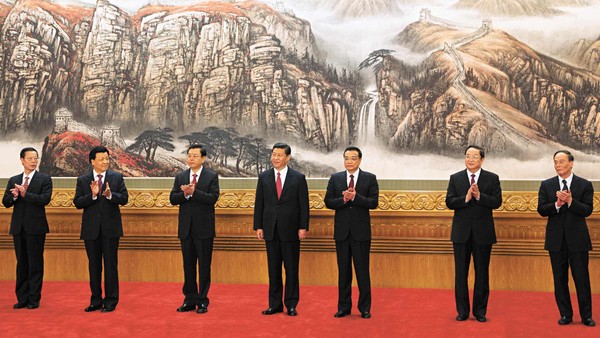
The 18th National Congress of the Communist Party of China has just finished in Beijing.  Xi Jinping, 59, and Li Keqiang, 57, will take over.  The debate within the leadership will continue about which way to take China: towards a full market economy open to the winds of global capital flows or to stay as they are.  The view of the media and ‘experts’ in the West seems to be that the new seven-man (and they are all men – see below) standing committee is broadly in favour of the status quo: dont’ rock the boat.  If it works, don’t fix it.  Sure, the new leader Xi talks about getting closer to the people, bearing down on corruption, reducing inequality etc.  But so do all Chinese leaders say this when they take over.    There is no evidence that Xi will do any of this, or even move in any radical way towards American-style capitalism.
Old and new – spot the difference!

Xi’s father Xi Zhongxun was a reform-minded Communist leader who was purged during the Cultural Revolution. Restored by Deng Xiaoping, he became the governor of Guangdong where he contributed to the pioneering economic reforms of Shenzhen in the 1980s.   Xi has been promoted by the Shanghai faction of the Party, known for its market-driven focus, and former President Jiang Zemin. But he also rests upon the more ‘conservative’ faction like Hu Jintao and Communist Youth League (CYL).  Xi emphasises the need for “collective responsibility” which he defined as the absence of individual interests among the party members. ie let’s stick together.
A year ago, when Beijing was pondering the 12th 5-year plan, Xi  supported an acceleration of ‘economic reforms’, namely the new growth model presented in the “China 2030” project with the Chinese State Council and the World Bank.  This report (see my previous post of last March, http://thenextrecession.wordpress.com/2012/03/23/which-way-for-china-part-two/) is a clear step towards an outright market economy that drastically reduces the role of the state and opens up the domestic economy to foreign capital even more.  The argument of the Sinology ‘experts’ of mainstream economics is that only this will enable China to escape from the so-called ‘middle income trap’.  They mean that, to begin with, ‘emerging economies’ can grow fast with big capital investment and exports using cheap labour and new technology – the Chinese model.

But less than a fifth of the 180 countries in the world have made it to being advanced economies. This chart, from the World Bank’s report makes the same point. Of the 101 countries that were “middle-income” in 1960, only 13 had managed to break from the pack to become advanced economies by 2008.
World Bank chart

One reason why countries get stuck in this “middle-income trap” is that they reach what is known as the “Lewis Point“, after the left economist of the 1950s, Arthur Lewis.  Put simply, this is the point at which a developing country stops being able to achieve rapid growth relatively easily, by simply taking rural workers doing unproductive farm labour and putting them to work in factories and cities instead.  But once this ‘reserve army of labour’ is exhausted, urban wages rise, incomes reach a certain level and a ‘middle-class’ emerges.  Distorting Lewis’ theory, mainstream economics asserts that then there must be a switch to boosting domestic consumption that a state-led economy cannot do.  So the cry is “Liberalise with free trade and capital – that’s the only way to move on”.  Typical of these arguments are the comments of  James McGregor, author of the 2012 book “No Ancient Wisdom, No Followers: The Challenges of Authoritarian Capitalism.” He commented “China’s done well in building infrastructure and getting the nation where it is but state industry is choking off economic growth so they have to re-ignite private industry.”

But the new Chinese leaders are divided on what direction to take.  For example, one of the new leaders is Zhang Dejiang from Sichuan province who wants keep things as they are.  For him, state-owned enterprises must strive to be “stronger, more excellent and bigger,”. Under his watch, some private auto companies including Zhejiang Gonow Auto Co. were merged into state-run competitors in a process described in Chinese as “the state advances and the private sector retreats.”  And state-run companies still dominate.   In another leader, Zhang Gaoli’s city, the indebted state-owned Tianjin City Infrastructure Construction & Investment Group has projects including construction of a new financial district modeled on Manhattan. It sold a 3 billion yuan ($481 million) one-year note in March at a 4.36 percent coupon, 220 basis points below the one-year bank lending rate at the time.  By contrast, small entrepreneurs in Tianjin can get unsecured loans for 2 percent interest per month, or more than 26 percent a year, according to the 3g210.com website, which provides loan interest rate information.  This is not what the Western capitalist ‘experts’ want to see.

And Left economist John Ross takes a different view (http://ablog.typepad.com/keytrendsinglobalisation/2012/10/investment-will-boost-chinas-economy.html).  Raising consumption – i.e. living standards indeed should be economic policy’s aim.  But unfortunately< Ross argues, this became confused with a different idea of sharply increasing the percentage of consumption in China’s GDP. These two goals are actually contradictory as GDP growth is largely driven by investment, and this underpins sustainable consumption.  But sharply increasing consumption’s percentage in GDP cuts investment levels, thereby inadvertently leading to lower GDP and consequently lower consumption growth.  This  illustrates why the phrase ‘consumer-led growth’ is confused.

China has grown by just under 10% a year, on average, since 1980. If it can grow by at least 6% or 6.5% a year from now on, the World Bank reckons it can graduate to become a high-income country before 2030 and overtake the US as the world’s largest economy. (China’s income per head, of course, would still be much lower than America’s.)  But this is by no means guaranteed.  Every developed economy has made this fundamental transition. But few, if any, have done it while continuing to increase productivity – output per head – by 6-7% a year. America, Europe and Japan had the advantage of a growing labour force for most of this stage in their development. China will not. Its population is ageing much more rapidly and its labour force will be shrinking after 2016.
How can we judge  whether China will continue to grow at that sort of rate?  In my earlier post, I argued that China cannot be seen as just another capitalist economy,.  But even so, the law of value does operate in China, mainly through foreign trade and capital inflows, as well as through domestic markets for consumption goods, services and funds.  In so far as it does, profitability becomes key to investment and growth.  So what has happened to China’s profitability in the last 30 years?  There have been various attempts to estimate the rate of profit in China.  I did so in my book, The Great Recession, chapter 12.  There are other studies that reach slightly different conclusions than I did (Zhang Yu and Zhao Feng, 2006, www.seruc.com/bgl/paper%202006/Zhao-Zhang.pdf; and Mylene Gaulard, 2010, http://gesd.free.fr/m6gaulard.pdf ).

I found that there were three cycles of profitability.  Between 1978-90, there was an upswing as capitalist production expanded through the Deng reforms and the opening up of foreign trade.  But from 1990 to the end of that decade, there was a decline, as over-investment gathered pace and other economies, particularly in the emerging world went through a series of crises (Mexico 1994, Asia 1997-8, Latin America 1998-01).  The falling rate of profit then was accompanied by slowing in the rate of GDP growth.  Then from about 1999 onwards, there was a rise in profitability, which also saw a significant rise in the rate of China’s economic growth (as the world too expanded at a credit-fuelled pace).

We are now getting better data from China to work with and I have just done further work on the Chinese rate of profit.  It looks as though profitability peaked in 2004.

After 2007, the slump in world capitalism drove down Chinese profitability.  Rising wages were not matched by increased sales abroad, so the rate of surplus value slumped (green line) while investment in fixed capital remained high (red line).  So profitability fell.

Inevitably, this has had a deleterious effect on GDP growth, as profits lead investment and investment leads growth, particularly in China.


Globalisation and the law of value in world markets feed through to the Chinese economy.  And the effect has been pernicious for the majority of Chinese.   Inequality of wealth and income under China’s ‘socialism with Chinese characteristics’ has never been so bad.  China’s Gini coefficient, an index of income inequality, according to Sun Liping, a professor at Beijing’s Tsinghua University, has risen from 0.30 in 1978 when the Communist Party began to open the economy to market force 0.46.  (and see my recent post on this)  China’s Gini coefficient has risen more than any other Asian economy in the last two decades.  The rise in inequality is partly the result of the urbanisation of the economy as rural peasants move to the cities.  Urban wages in the sweatshops and factories are increasing, leaving peasant incomes behind (not that those urban wages are anything to write home about when workers assembling Apple i-pads are paid under $2 an hour).  But it is also partly the result of the elite controlling the levers of power and making themselves fat, while allowing some Chinese billionaires to flourish.

Is mainstream economics right to argue that people’s needs and aspirations can only be met by a capitalist economy?  The evidence of the Great Recession and the ensuing long depression suggests otherwise.  If the capitalist road is adopted by the new leaders and the law of value becomes dominant, it will expose the Chinese people to chronic economic instability (booms and slumps), insecurity of employment and income and greater inequalities.  On the other hand, if the surplus created by the Chinese people remains under the control of an elite backed by an army and police and ruling without dissent, then the needs and aspirations of a more affluent and educated population will not be met.  The key to continued growth and more equality will be democracy.  China needs to move from so-called ‘socialism with Chinese characteristics’ (i.e. a state-led economy under a corrupt autocracy) to a China with socialist foundations (democratic planning and equality).  China cannot just stay as it is, whatever its new leaders might hope.

Senin, 12 November 2012

Monsters, delusions of debt and the crisis

by Michael Roberts

I have just attended the 9th Annual Historical Materialism conference in London.  It was an opportunity to catch up with some of  the latest academic Marxist research from around the world.  I also presented a paper at the HM conference, but more of that later.  The big headline session is when the previous year’s winner of the Isaac Deutscher prize for the best Marxist book of the year makes an address and this year’s winner is announced.  Last year’s address was by David Harvey.  You can read my comments on his presentation in a previous post (David Harvey, Marx’s method and the enigma of surplus, (http://thenextrecession.wordpress.com/2011/11/13/david-harvey-marxs-method-and-the-enigma-of-surplus/).

This year’s winner was David McNally.  This was not unexpected.  McNally has already written an excellent account of the recent capitalist crisis, called Global Slump: The economics and politics of crisis and resistance on which I have commented before (see http://thenextrecession.wordpress.com/2011/10/26/the-debate-on-the-rate-of-profit-yet-again/)  and http://thenextrecession.wordpress.com/2012/05/14/choonara-mcnally-and-the-us-rate-of-profit/. This book is called Monsters of the Market: zombies, vampires and global capitalism.  As its title suggests, it is an exotic and stimulating analysis of global capital and its crises, drawing on the folklore of occult culture with terms like monsters, zombies  and vampires, also used by Marx in his accounts of capitalism.

I have to be honest and say that I do know always where McNally is going with this roller coaster of a read.  But I think it is something like the idea of showing that capitalism really is a monstrous system that sucks the blood (vampire-like) out of living labour and turns human beings into robotic zombies.  Capitalism turns human beings into commodities even by selling their body parts after their death (and sometimes before death).  The language of monsters and vampires is not so much a metaphor of the capitalist mode of production, but a reality. “Capital is dead labour which, vampire-like, lives only by sucking living labour” (Marx).  Human beings are separated from their product of their work by capital and market exchange and can even become part of the process of exchange themselves.  Under capitalism, human beings are disempowered and become lifeless like zombies.  But all is not lost because the zombies and monsters can fight back as Frankenstein’s monster did.  Indeed, human beings can kill the monsters of the market.  It’s certainly a different angle on the nature of social relations under capitalism.  But I do prefer the  more prosaic but compelling analysis in McNally’s earlier books on the market (Against the Market, 1993) and capitalist crisis (Global slump, op cit).

Readers of this blog will know that, being very prosaic myself, that I would mainly be interested in the latest research on the economic crisis.  In this area, two papers at the HM conference attracted me.  The first was by Sergio Camara, whose paper aimed at identifying the contribution that finance capital made during the so-called neo-liberal era from the 1980s onwards towards boosting the profitability of US capitalism.  Camara measures what he called the return on ‘active capital’ (basically non-financial capital) against the real rate of interest (which was his measure of the profitability of financial capital).  Camara found that real interest rate was higher than the return on active capital up to the end of the 1990s, after which the reverse was true.  Thus, the turning point and a marker for the end of the neo-liberal era was then.  I’m not sure his measure of financial profitability is right, but the turning point rings true with me and also matches the conclusions of an earlier paper by Camara, which I highly recommend as showing how profitability is the key causal factor in this capitalist crisis (Izquierdo rate of profit).

Professor Simon Mohun also presented a paper that tries to develop the idea of a ‘class rate of profit’.  Mohun has raised this concept before and at the time I had severe objections to his attempt to redefine Marx’s definition of class and consequently the measurement of the rate of profit, (see http://thenextrecession.wordpress.com/2012/01/23/a-class-rate-of-profit/).   And my misgivings were not helped by Mohun’s statement that he did not think that Marx supported the idea of any law of the tendency of the rate of profit to fall.  But I have to say the paper was interesting, not least because its measurement of the US rate of profit (whether conventionally done or under Mohun’s ‘class’ definition) showed that profitability started to fall from 1997 and that US capitalism was in a downphase.  This, of course, is one of my key arguments.

That brings me to my paper (see here:Debt matters). It is on debt and its connection to the rate of profit and crises.  Anybody who has read my blog knows that I have been arguing that the reason for the weak economic recovery since the end of the Great Recession is two-fold.  First, the rate of profit in most major capitalist economies has not recovered and we remain in a downphase for profitability.  And second, the sheer weight of fictitious capital (mainly debt) is holding down the ability of the productive sectors of capitalism to restore investment and growth.

My paper quantifies the expansion of fictitious capital since the 1980s in the neo-liberal period and then attempts to measure profitability against not just tangible (physical) capital but also against fictitious capital.  It draws on the work of Alan Freeman, Tony Norfield and others is in trying to do this (their papers are cited in mine).

For me, capitalist crises can be triggered by the expansion of private sector debt rather than public sector debt that obsesses mainstream economics for both ideological and class interests.  In the neo-liberal era from the early 1980s up to the late 1990s, debt expanded dramatically and so did financial sector profits.

In measuring corporate profits against net worth of corporations (tangible + financial assets less financial liabilities) in the US, I find that the non-financial corporate sector no longer benefited from the expansion of fictitious capital after the end of the 1990s.  Indeed, profitability against net worth was lower than the rate of profit against tangible assets by the early 2000s – echoing Camara’s conclusions (see above).


The neoliberal expansion in fictitious capital that had helped push capitalism out of the crisis of the 1970s was now laying the basis for new crises and slumps.  The credit crash led to the bailing out of the banks by the state and sovereign debt then rocketed.  Capitalism is now left with a huge debt burden in both the private and public sector that will take years to deleverage in order to restore profitability.  So, contrary to the some of the conclusions of mainstream economics, debt (particularly private sector debt) does matter. Indeed, assuming growth does not return soon, precisely because debt remains too large, there are only two ways to reduce the debt burden.  The first is through inflation (reducing the real value of the debt) for debtors at the expense of creditors.  That’s the Keynesian solution.  The other way is through default (you might call it the Marxist way).  This is the quickest way but the most painful for capitalism and the creditors.  For some capitalist economies like Greece, there is no choice: default is the only exit.

Comments from the floor on my paper only increased my misgivings about the approach of the paper.  The first was a point made by Professor Fred Moseley that I had left out the role and impact of the growth in financial debt (i.e the debt of the banks and other financial institutions) and thus the nexus between that household and sovereign debt.  The finance sector borrowed in order to lend to households to fuel the property bubble.  When that bubble burst, banks got deep into trouble and their debts had to be covered by the state.  The banks could then deleverage their worthless assets at the expense of taxpayers, while households defaulted on their mortgages.  So it was from households to banks to government; passing the parcel of debt.  I am going to have to try integrate this into my calculations on profitability.

The other misgiving is that I am not sure my current attempt to measure profitability against advanced capital that includes financial assets and liabilities works.  At the conference, Tony Norfield presented a paper that modified Marx’s formula for the rate of profit that incorporated finance capital.  This may be a better way forward. Tony has an excellent blogsite where his papers are available (http://economicsofimperialism.blogspot.co.uk/).  He produced some great data on how US and UK capitalism are the pre-eminent ‘rentier’ imperialist powers in the world. His index of imperialism, for example, based on GDP, military power, FDI, bank assets and foreign currency transactions is a real eye-opener.

As readers know, I am convinced that the most compelling explanation of the global slump is to be found by starting with profits and then from the movement in profitability of capital to investment, wages and consumption.  But most don’t agree, even most Marxists.  There are other explanations of the crisis that are based on the view that there is inadequate ‘effective demand’ (Keynesians) and the more sophisticated version that might be described as post-Keynesians.  If you want to read the basic ideas and key papers of the post-Keynesians go to http://hussonet.free.fr/postk.htm.

Ozlem Onaran and Giorgos Galanis presented a paper (Distribution, growth and the crisis: implications for the global economy) that they said was based on neo-Kaleckian theory.   This approach relies on the work of Michel Kalecki, the Polish radical economist who merged Marxist ideas with Keynesian ones.  I have commented on Kalecki’s ideas in many previous posts.  Neo-Kaleckian theory is an attempt to combine the Marxist law of profitability as the cause of crisis with the Keynesian one based on the lack of effective demand, if you like.  Onaran and Galanis analysed the changes in wage and profit share across a large number of capitalist economies since 1960. They argue that the evidence shows that the crisis was ‘wage-led’ not ‘profit-led’.  In other words, it was the fall in labour’s share that eventually led to a lack of demand and this triggered a collapse in investment and growth.  Indeed, if labour’s share had been sustained at 1970s levels, the golden age of economic growth would have been maintained during the neo-liberal era.  So the crisis of capitalism after the 1980s was due to a lack of wages not a lack of profits.  I think you can find their paper at the International Labour Organisation site.

Now I have problems with this thesis both on theoretical and empirical grounds.  Theoretically, the Kalecki-Keynesian view of the capitalist economy is the wrong way round (in particular see my post, http://thenextrecession.wordpress.com/2012/06/26/profits-call-the-tune/).  If crises are not profits led, then the solution to crisis could be just by raising wages.  Ah! say the neo-Kaleckians, well then there would be a profit-led crisis as wages squeezed profits.  And anyway, capitalists would politically block any move to raise wages even if it is rational to do so.  Now I accept that the collapse in labour’s share was a neo-liberal response to the profitability crisis of the 1970s.  It helped to drive up the rate of surplus value and counteracted falling profitability.  But profitability was still lower than in the golden age in 1997.  And it has been falling (on a trend) from 1997.  We may have a correlation between declining labour share and low growth.  But which way is the causation?  Is it not low profitability to poor investment and thus to low growth, forcing capitalism to squeeze labour?

And I have to comment on a sort of debate between Professors Riccardo Bellofiore and Fred Moseley on Marx’s schema for understanding capital and surplus value (Hegel and Marx: lost in translation; the universal and particulars in Hegel’s logic and Marx’s theory of capitalism).  It seemed to me that what was really behind the so-called difference in translating between the German for Hegelian concepts of  ‘appearance’, ‘false appearance’ and ‘essence’ in capitalism was being used by RB to suggest that capital (as money) was different from its value even at the level of ‘capital in general’.  RB seemed to be hinting that capital was more than a form (an appearance) of surplus value at this level of abstraction and thus Marx’s law of value does not explain ‘capital’ in full.  Maybe I am wrong, but that is what I concluded.  If so, this looks like a departure from Marx’s value theory, not a clarification.  Otherwise why make such a big fuss between surplus value and capital?

All this sounds pretty arcane, but when you read RB’s explanations of the crisis, which I think diverge from a Marxist view, this may be connected.  Last year Bellofiore argued that the euro crisis is really just part of an overall global debt crisis.  As he put it: “if only the economic analysis of the Left would have escaped obsolete readings, such as the tendential fall in the rate of profit or would have resisted the underconsumption temptation (according to which the global crisis was of a world of low wages), it could have seen in advance that was the collapse of ‘privatised Keynesianism’.  By privatised Keynesianism, Bellofiore means uncontrolled private debt expansion that creates an ‘imbalance’ in the capitalist economy which must eventually be corrected through a crisis.  Thus the cause of capitalist crisis is not the Marxist one of profitability or rising inequality (currently the vogue among non-mainstream heterodox economists), but uncontrolled debt, Minsky-style.  For more on this see my post (http://thenextrecession.wordpress.com/2011/10/07/riccardo-bellofiore-steve-keen-and-the-delusions-of-debt/).

I appreciated two main things from the many papers at the conference, of course, confirming my own prejudices!  The first is that the neo-liberal period is over.  The neo-liberal period was a response by capitalism to the profitability crisis of the 1970s in two ways: a) reducing the share of labour in total value to boost profitability and b) expanding fictitious capital (and unproductive labour) and investing in financial assets over real assets for higher profit.  That eventually collapsed because profitability never recovered to the level of the Golden Age (because of weakness of productive capital) and even started to fall back in the major capitalist economies after the late 1990s.  As a result, fictitious capital became levitated like the cartoon Road Runner before taking a big tumble.

The second is that the very weight of dead capital (fictitious and real) is so great that it will take years (decades?) to liquidate or devalue to restore profitability.  So we are in a Long Depression.  The monstrosities of the market have returned in a very dreaded way.